


Industrial HVLS Fans
Buy HVLS Industrial Fans from Alvina for warehouses, factories and large facilities across UAE, Saudi Arabia, Qatar and GCC.
HVLS Industrial Fans | Warehouse & Factory Fans Supplier in UAE
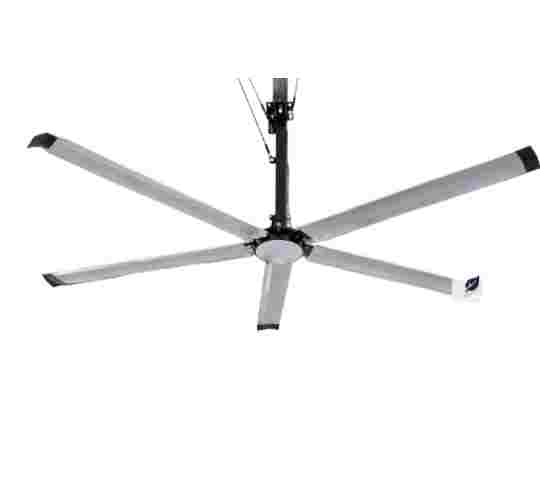
Industrial HVLS Fans are large-diameter ceiling fans made for warehouses, factories, workshops, logistics centres and other high-ceiling buildings. Their large aerodynamic blades move a broad volume of air at low rotational speed. Instead of producing a narrow blast, the fan spreads air across a much wider floor area. This makes HVLS systems useful where users want better air circulation around storage racks, machinery, workstations and production zones. Typical industrial models are available in sizes from around 8 ft to 24 ft, with direct-drive or geared motors and variable-speed control. They can also help reduce temperature layering in tall buildings by mixing warm ceiling air with the lower air zone. Alvina supplies HVLS Industrial Fans throughout the UAE, Saudi Arabia, Qatar, Bahrain, Kuwait and Oman, with selected supply to Egypt, Iraq, Kenya and France.
HVLS Industrial Fans for Warehouses, Factories and Large Facilities
Large buildings rarely have an airflow problem that can be fixed by adding a few small fans. A warehouse may have open doors and still feel warm inside. In a production hall, air can remain almost still between machines while heat collects high above the floor. Workers usually notice the discomfort first, but poor circulation can also affect how evenly a building feels from one area to another.
That is where HVLS Industrial Fans are useful. HVLS means High Volume Low Speed. These fans use a large blade diameter and comparatively slow rotation to move a wide body of air through the building. Instead of producing one strong stream, the fan creates a much broader airflow pattern. That makes it practical for warehouses, factories, logistics centres, workshops, manufacturing halls, hangars and other large indoor spaces.
Alvina supplies Industrial HVLS Fans across the UAE and GCC, including Abu Dhabi, Dubai, Sharjah, Saudi Arabia, Riyadh, Jeddah, Dammam, Qatar, Bahrain, Kuwait and Oman. Selected project supply is also available for Italy, France, Germany and Spain.
What are HVLS Industrial Fans?
An HVLS fan is a large-diameter ceiling fan made for wide-area air circulation. It works differently from a normal domestic ceiling fan. A smaller fan may move air well around one room or one workstation. In contrast, an HVLS unit is designed to influence a much larger floor area.mThe blades push a broad column of air downward. When that air reaches the floor, it spreads out across the building.
That movement can reach workstations, storage aisles, loading areas and open production zones. HVLS fans are also useful in tall buildings because warm air often collects close to the roof. The fan keeps the air mixed instead of allowing separate warm and cool layers to remain in place. This process is known as destratification.
The fan does not produce refrigerated air, so it should not be treated as an air-conditioning system. Its job is to move and mix the air already inside the building. In conditioned facilities, this can also help the HVAC system distribute air more evenly.
Key Features of Industrial HVLS Fans
- Large blade diameter gives the fan the ability to influence a wide floor area.
- Low-speed rotation provides broad airflow without the sharp draft created by some high-speed fans.
- Direct-drive and geared-drive options are available for different project requirements.
- Aerodynamic fan blades help move air efficiently through large spaces.
- Destratification reduces the separation between warm ceiling air and cooler lower air.
- Large-area coverage can reduce the number of individual fans needed in some buildings.
- Quiet operating options are available for facilities where noise matters.
- HVAC support makes the fans useful in conditioned warehouses and commercial spaces.
- Industrial construction suits demanding warehouse, factory and workshop environments.
Uses of HVLS Industrial Fans
- Warehouses: Keeps air moving between storage racks and picking areas.
- Factories: Improves circulation around production lines and machinery.
- Workshops: Reduces still air around engineering and maintenance work areas.
- Logistics Centres: Moves air through loading, sorting and dispatch zones.
- Assembly Halls: Provides broader airflow over occupied workstations.
- Hangars: Circulates air inside tall buildings with large open floor areas.
- Automotive Facilities: Works in workshops, service areas and production buildings.
- Sports Halls: Improves air movement across large indoor activity spaces.
- Commercial Facilities: Supports air circulation in high-ceiling halls.
- Agricultural Buildings: Can be used where wide-area circulation is needed in enclosed spaces.
Applications Across UAE and GCC
- Dubai: Logistics centres and warehouses install HVLS Industrial Fans where broad airflow is needed across storage and packing areas.
- Abu Dhabi: Workshops and industrial buildings use Industrial HVLS Fans in maintenance bays and production halls.
- Sharjah: Manufacturing and fabrication facilities use High Volume Low Speed Fans when normal ceiling fans do not provide enough reach.
- Saudi Arabia: Warehouses and factories use Industrial Ceiling Fans across large production and storage areas.
- Riyadh: Distribution facilities use Warehouse HVLS Fans to improve airflow around racking and picking zones.
- Jeddah: Warehousing and logistics operations use Large Industrial Fans around loading, packing and storage spaces.
- Dammam: Engineering facilities use HVLS Fans for Warehouse projects in high-ceiling industrial buildings.
- Qatar: Factories and storage facilities use Commercial HVLS Fans for wide-area circulation.
- Bahrain: Industrial users install Energy Efficient Industrial Fans alongside existing ventilation systems.
- Kuwait: HVLS systems are used in factories and warehouses where local fans do not provide enough coverage.
- Oman: Workshops and production areas use Industrial Air Circulation Fans to improve general airflow.
Alvina also supplies selected projects in Italy, France, Germany and Spain.
Technical Specifications
HVLS fans are not a one-size-fits-all product. The correct unit depends on the building.
| Specification | Typical Details |
|---|---|
| Product Name | Industrial HVLS Fans |
| Fan Type | High Volume Low Speed Ceiling Fan |
| Installation | Ceiling Mounted |
| Typical Diameter | Approx. 8–24 ft depending on model |
| Drive Options | Direct Drive / Gear Drive |
| Speed Control | Variable Speed / Electronic Controller |
| Motor Type | Model dependent |
| Blade Material | Commonly aluminium aerofoil blades |
| Typical RPM | Low-speed operation; model dependent |
| Main Function | Large-area air circulation |
| Secondary Function | Air mixing and destratification |
| Typical Locations | Warehouses, Factories, Workshops, Logistics Centres |
| Electrical Supply | Depends on fan model and country |
| Coverage Area | Depends on diameter, height and layout |
| Noise Level | Model dependent |
| Installation Review | Structural and fire-system coordination required |
How Do HVLS Industrial Fans Work?
The operating principle is quite simple. The large blades move a wide column of air toward the floor. When the air reaches floor level, it does not stop beneath the fan. It spreads outward. From there, it moves past machinery, storage racks and work areas before gradually returning upward. This creates a slow circulation loop through the building.
The result feels different from a small high-speed fan. Instead of receiving a strong blast in one spot, people across a much larger area experience gentle air movement. In a tall warehouse, this circulation also helps bring warm air down from the ceiling area. Placement matters just as much as fan size.
A large fan installed too close to a wall, roof beam, crane or storage rack may not distribute air properly. For this reason, project layout should be reviewed before installation.
Certifications, Standards and Compliance
- ANSI/AMCA Standard 230-23 – Air Circulating Fan Performance
- AMCA Certified Ratings Program – AMCA certification can verify published performance ratings for qualifying fan models.
- NFPA 13 – Sprinkler System Coordination
- IEC Standards
- CE Marking
For project approval, request the exact fan datasheet, motor information, controller details, mounting drawing, electrical certificates and AMCA documentation where applicable.
Why Choose HVLS Industrial Fans from Alvina?
- Covers large indoor spaces with broad airflow.
- Works well in warehouses and high-ceiling buildings.
- Available in several diameters and drive designs.
- Can operate alongside existing HVAC systems.
- Helps reduce stagnant zones around large work areas.
- Variable-speed control allows easier airflow adjustment.
- Suitable for manufacturing, logistics and storage projects.
- Supply is available throughout the UAE and GCC.
- Selected European project supply is also available.
Frequently Asked Questions
1. What does HVLS mean?
HVLS stands for High Volume Low Speed, referring to large fans that move a high volume of air at relatively low rotational speed.
2. Where are HVLS Industrial Fans used?
They are commonly used in warehouses, factories, workshops, logistics centres, hangars and large commercial buildings.
3. How large can HVLS fans be?
Industrial models are commonly available from around 8 ft up to 24 ft, depending on the manufacturer and project.
4. Do HVLS fans actually cool a building?
They do not refrigerate the air, but the movement of air can improve comfort and reduce stagnant hot areas.
5. Can HVLS fans work with air conditioning?
Yes, they can improve air mixing and help distribute conditioned air through suitable large spaces.
6. Can HVLS fans be installed in sprinkler-protected warehouses?
Yes, but fan placement and shutdown requirements must be coordinated with the applicable fire-protection design.
7. Where does Alvina supply HVLS Industrial Fans?
Alvina supplies them across the UAE, Saudi Arabia, Qatar, Bahrain, Kuwait and Oman, with selected supply to Italy, France, Germany and Spain.
Conclusion
A warehouse with poor air movement can feel uncomfortable even when the actual temperature is not extreme. The same problem appears in workshops, factories and logistics buildings. Adding more small fans is not always the most practical answer.
HVLS Industrial Fans approach the problem by moving a much larger body of air slowly across the space. Their large blades create wide circulation, helping air reach storage aisles, machinery areas, workstations and open production zones. They can also reduce temperature layering in high buildings by mixing warmer air from the roof area with the lower part of the building.
Different projects will need different fan diameters, motor types and mounting positions. The final choice should therefore depend on the real building rather than on fan size alone.
For users searching for Industrial HVLS Fans, High Volume Low Speed Fans, Industrial Ceiling Fans, Warehouse HVLS Fans, Large Industrial Fans, HVLS Fans for Warehouse, Commercial HVLS Fans, Energy Efficient Industrial Fans or Industrial Air Circulation Fans, Alvina can supply suitable options for warehouse and industrial projects.


Woman fashion dress
Price : $387But I must explain to you how all this mistaken idedenounc pleasure and praisi pain was born and I will give you a complete accosystem, and expound the actu teachings of the great explore tmaster-builder of human happiness. No one rejects, dislikes, or avoids.