


M-138 Rubber Additive/M138C
Buy M-138 VCI Rubber Additive for built-in metal corrosion protection in gaskets, seals and elastomers, supplied across the UAE and GCC by Alvina.
M-138/M138C | VCI Rubber Additive Supplier in Qatar, Oman, UAE
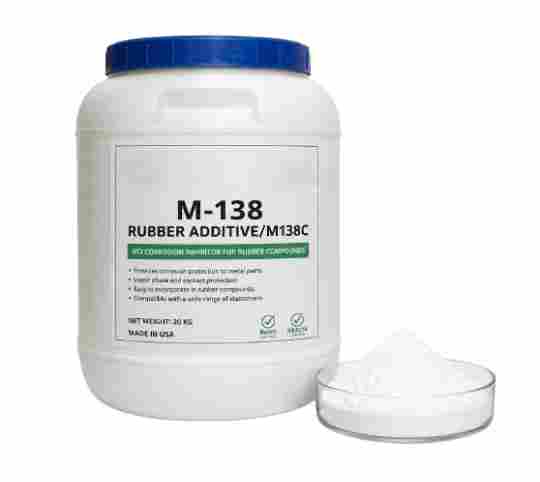
M-138 Rubber Additive/M138C is a powdered VCI Rubber Additive designed to provide built-in corrosion protection in rubber, sealant and elastomer compounds. It can be mixed into compatible nitrile rubber, EPDM and other elastomers during normal compounding. After curing, the treated rubber helps protect metal through direct-contact and vapour-phase corrosion inhibition. This makes it suitable for gaskets, seals, O-rings, rubber rollers, reinforced hoses, belts, rubber sleeves and rubberised coatings. M-138 can support the protection of carbon steel, galvanized steel, stainless steel, aluminium, copper, brass and bronze. It is especially useful in enclosed assemblies where conventional coatings may be difficult to apply. The product is supplied in polyethylene-lined drums and offers a shelf life of up to two years under recommended storage conditions. Alvina supplies M-138 Rubber Additive/M138C across the UAE, Saudi Arabia, Qatar, Oman, Kuwait and Bahrain for industrial rubber and corrosion-control applications.
VCI Rubber Additive in UAE – M-138 Rubber Additive/M138C
VCI Rubber Additive Rubber parts are often fitted directly against metal. A gasket may sit between two steel flanges, an O-ring may seal a metal housing, or a rubber sleeve may cover an equipment joint. These parts can perform their sealing job well, yet moisture trapped around them may still cause rust.
The risk becomes higher in humid factories, coastal workshops, cooling systems and equipment that remains idle for long periods. Corrosion may begin beneath the rubber, where it is difficult to notice during routine inspection. Once the damage develops, the result can be staining, pitting, leakage or an early replacement of the metal component.
M-138 Rubber Additive/M138C offers another way to handle this problem. The VCI Rubber Additive is introduced into a compatible rubber, sealant or elastomer formulation during production. The finished rubber component can then provide corrosion protection to nearby metal surfaces.
Alvina supplies M-138 Rubber Additive/M138C across the UAE, including Dubai, Abu Dhabi, Sharjah, Ajman, Fujairah, Ras Al Khaimah and Umm Al Quwain. Supply support is also available for manufacturers and industrial users in Saudi Arabia, Qatar, Oman, Kuwait and Bahrain.
What is M-138 Rubber Additive/M138C?
M-138 is a powder-form corrosion inhibitor developed for use in rubber compounds, sealants and other compatible elastomer systems. It is added while the compound is being prepared rather than applied later as a separate coating.
Once the treated rubber is cured and placed close to metal, the corrosion inhibitor works at the rubber-to-metal interface. M-138 also provides vapor-phase protection. In a closed or partly enclosed space, protective molecules can move from the treated elastomer and reach metal areas that are not touching the rubber directly.
This dual action makes the product useful for components such as gaskets, seals, O-rings, reinforced hoses, belts, rollers and protective rubber sleeves. It can be considered for nitrile rubber, EPDM and other elastomeric materials after formulation trials.
M138C is a related corrosion-inhibiting grade. The correct choice between M-138 and M138C should be based on the rubber compound, the metals involved and the required end performance. Manufacturers should therefore complete laboratory testing before starting commercial production.
How Does the VCI Rubber Additive Work?
Normal rubber can hold moisture against a metal surface. Certain ingredients in an elastomer may also contribute to staining or corrosion, particularly when the assembly contains different metals.
Adding M-138 VCI Rubber Additive changes the role of the rubber part. Instead of working only as a seal, cushion or protective cover, the treated component also becomes a source of corrosion inhibitors.
Protection takes place in two ways:
- Contact protection supports metal surfaces that touch the treated rubber.
- Vapor-phase protection reaches nearby metal within an enclosed space.
The protective layer is molecular and generally does not need to be removed from the metal before the equipment is put into normal service. However, the completed rubber formulation must still be evaluated for curing, strength, adhesion, hardness and compatibility.
Key Features of VCI Rubber Additive
- Works as a VCI Rubber Additive for suitable elastomer and sealant compounds.
- Builds corrosion protection into the finished rubber component.
- Offers both contact and vapor-phase metal protection.
- Helps reduce rust where rubber and metal remain together.
- Useful for assemblies containing more than one metal type.
- Suitable for gaskets, O-rings, seals, belts, hoses and rubber sleeves.
- May reduce dependence on oily rust preventives or additional protective coatings.
- Supplied as a powder for introduction during rubber compounding.
- Suitable for industrial components used in humid and coastal GCC conditions.
- Available through Alvina across UAE and wider GCC markets.
Uses of VCI Rubber Additive
Gaskets and Flange Seals
Gaskets often sit between metal faces where water or process moisture may collect. A corrosion-inhibiting gasket can support protection around the flange surface while continuing to provide the required seal.
O-Rings and Industrial Seals
O-rings are used in pumps, valves, tools, hydraulic systems and equipment housings. Adding corrosion protection to the elastomer can help protect the metal groove and nearby components.
Rubber Rollers
Metal shafts and cores inside industrial rubber rollers may be difficult to inspect. M-138 can be considered where built-in protection is required between the rubber and metal section.
Reinforced Hoses and Belts
Hoses and belts may contain wire reinforcement or other metal parts. A compatible Corrosion Inhibitor for Rubber can help protect these internal components from moisture-related corrosion.
Rubber Sleeves and Joint Covers
A treated sleeve can provide vapor protection around enclosed couplings, fittings and equipment joints, including areas that do not make direct contact with the rubber.
Electronic Shielding Gaskets
Conductive or shielding gaskets may contain metal particles. Corrosion inhibitor technology can support protection where these gaskets meet electronic housings and other metal surfaces.
Boilers and Cooling Equipment
Gaskets used in boilers, strainers and cooling towers frequently operate near water. Built-in corrosion protection may help reduce damage around sealed metal connections.
Applications Across UAE and GCC
Dubai: Suitable for gasket manufacturers, rubber compounders, automotive suppliers, engineering workshops and industrial component producers.
Abu Dhabi: Useful for oil and gas equipment, valve seals, pipeline components, maintenance parts and offshore support applications.
Sharjah: Supports rubber moulding companies, fabrication workshops, machinery repair businesses and seal manufacturers.
Ajman: Suitable for small and medium rubber-product manufacturers, gasket cutters and industrial maintenance suppliers.
Fujairah: Useful for marine workshops, port equipment, hose assemblies, ship maintenance and other coastal applications.
Umm Al Quwain: Suitable for rubber workshops, fabrication businesses, equipment repair and general industrial component production.
Saudi Arabia: Available for companies in Riyadh, Dammam, Jubail, Jeddah and Al Khobar working with oilfield seals, industrial hoses, gaskets, rollers and rubber components.
Qatar: Useful for oil and gas suppliers, gasket companies, equipment maintenance contractors and seal manufacturers in Doha and surrounding industrial areas.
Oman: Suitable for marine industries, ports, processing plants, fabrication workshops and rubber component suppliers.
Kuwait: Can support refinery maintenance, oilfield equipment, industrial seals, hose systems and storage applications.
Bahrain: Useful for marine services, aluminium industries, industrial maintenance, fabrication and machinery component production.
Technical Specifications
| Specification | Details |
|---|---|
| Product Name | M-138 Rubber Additive/M138C |
| Product Category | VCI Rubber Additive |
| Product Form | Powder |
| Main Function | Built-in corrosion protection for rubber, sealant and elastomer compounds |
| Protection Method | Contact and vapor-phase corrosion inhibition |
| Compatible Materials | Nitrile rubber, EPDM and other compatible elastomers after testing |
| Typical Components | Gaskets, O-rings, seals, hoses, belts, rollers and rubber sleeves |
| Metal Coverage | Multi-metal protection, subject to grade and formulation compatibility |
| Addition Stage | Introduced during rubber or elastomer compounding |
| Application Requirement | Laboratory compatibility and performance testing before full production |
| M-138 Packaging | 100 lb / 45.5 kg polyethylene-lined drums |
| M-138 Storage | Store sealed in a dry warehouse below 100°F / 38°C |
| M-138 Shelf Life | Up to two years under recommended storage conditions |
| Supplier | Alvina |
| Supply Region | UAE, Saudi Arabia, Qatar, Oman, Kuwait and Bahrain |
Certifications, Standards and Compliance
The public product information identifies M-138 as an additive for corrosion-inhibiting rubber and sealant systems. However, a specific certification should not be claimed for a finished rubber component unless the completed formulation has been tested and approved.
ISO 814 – Rubber-to-Metal Adhesion Testing
ASTM D395 – Rubber Compression Set
AMPP Corrosion Standards
GHS – Globally Harmonized System
REACH Regulation
Why Choose M-138 Rubber Additive/M138C from Alvina?
Many corrosion problems around seals are discovered only after the equipment is opened. The exposed surfaces may look clean from the outside, while rust has already developed under the gasket or inside a covered joint.
M-138 addresses the problem at the material level. Corrosion protection becomes part of the rubber component, so manufacturers do not have to rely only on an external oil, grease or coating. This approach can simplify assembly and may also leave metal parts cleaner during servicing.
Manufacturers developing gaskets, seals, hoses, belts and moulded rubber parts for humid or coastal locations often choose this product. Its contact and vapor-phase action supports areas that ordinary surface treatments may not reach easily.
Alvina supplies M-138 Rubber Additive/M138C across UAE, with support for customers throughout Saudi Arabia, Qatar, Oman, Kuwait and Bahrain. Manufacturers can also request available technical documents before completing their formulation trials.
Frequently Asked Questions
1. What is M-138 Rubber Additive used for?
It is compounded into rubber, sealants and elastomers to provide built-in corrosion protection for nearby metal parts.
2. How does M-138 protect metal?
It provides contact protection and releases vapor-phase inhibitors that reach metal surfaces inside enclosed areas.
3. Which rubber materials can use M-138?
It can be considered for nitrile rubber, EPDM and other compatible elastomers after laboratory testing.
4. What components can contain this additive?
Common examples include gaskets, O-rings, seals, hoses, belts, rollers and protective rubber sleeves.
5. Does M-138 protect more than one metal?
Yes, M-138 is intended for multi-metal protection, but the exact metal combination should be tested in the final compound.
6. Are M-138 and M138C exactly the same?
They are related corrosion-inhibiting grades, but their suitability should be confirmed against the required metal and formulation.
7. Will the additive change the properties of rubber?
A properly developed formulation may retain its required properties, but curing, hardness, strength and compatibility must be verified through testing.
8. Where does Alvina supply M-138 Rubber Additive/M138C?
Alvina supplies the product across UAE, Saudi Arabia, Qatar, Oman, Kuwait and Bahrain.
Conclusion
M-138 Rubber Additive/M138C provides a practical way to build corrosion protection into rubber and elastomer components. Instead of treating the metal only after assembly, manufacturers can introduce the inhibitor while preparing the rubber compound.
The finished gasket, O-ring, seal, hose, belt or sleeve can then help protect metal through direct contact and vapor action. This is particularly valuable around joints, enclosed equipment and mixed-metal assemblies where moisture may remain unnoticed.
Rubber compounders, seal manufacturers, hose producers, industrial maintenance suppliers and engineering companies can use this product. Each manufacturer should still complete careful formulation testing, since each elastomer and curing system behaves differently.
Alvina supplies M-138 Rubber Additive/M138C throughout UAE and supports industrial requirements in Saudi Arabia, Qatar, Oman, Kuwait and Bahrain. For companies searching for a VCI Rubber Additive, Corrosion Inhibitor for Rubber, VCI Additive for Elastomers or Metal Protection Rubber Additive, M-138 offers a useful route to built-in corrosion control.


Woman fashion dress
Price : $387But I must explain to you how all this mistaken idedenounc pleasure and praisi pain was born and I will give you a complete accosystem, and expound the actu teachings of the great explore tmaster-builder of human happiness. No one rejects, dislikes, or avoids.