


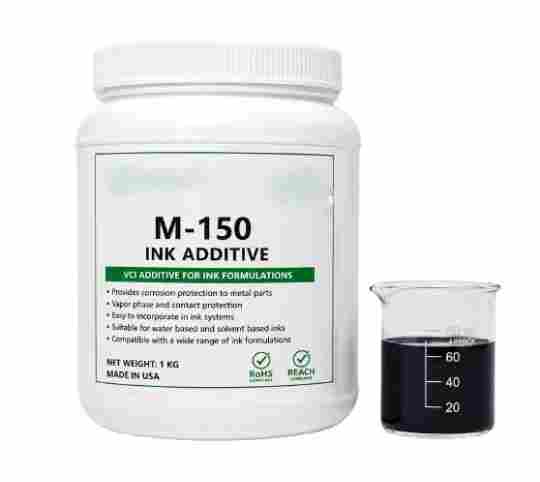
M-150 Ink Additive
VCI Ink Additive M-150 adds multi-metal corrosion protection to water-based inks and printed packaging. Supplied by Alvina across UAE and GCC.
VCI Ink Additive | M-150 Supplier in Qatar, Oman, Kuwait, UAE
M-150 Ink Additive is a liquid VCI Ink Additive developed for water-based inks and similar printable formulations. Manufacturers blend it into compatible ink systems to give printed paper, film or packaging material added corrosion-protection properties. Once applied to a suitable carrier, the finished ink layer can support metal protection inside packages and enclosed spaces.
M-150 offers multi-metal protection, making it useful for industrial packaging, export wrapping, printed corrosion-control papers and other ink-like protective systems. The formulation requires laboratory testing because pigment type, binder chemistry, printing method and drying conditions can influence performance.
Alvina supplies M-150 Ink Additive throughout UAE, including Dubai, Abu Dhabi, Sharjah, Ajman, Fujairah, Ras Al Khaimah and Umm Al Quwain. Alvina also supports industrial customers in Saudi Arabia, Qatar, Oman, Kuwait and Bahrain.
VCI Ink Additive in UAE – M-150 Ink Additive
VCI Ink Additive or Printing ink usually carries colour, branding or handling instructions. However, in industrial packaging, ink can perform another job as well. With the correct corrosion inhibitor, a printed layer can help protect metal goods packed inside paper, board or suitable film.
This is where M-150 Ink Additive becomes useful. Manufacturers add it to compatible water-based ink and ink-like formulations during production. The resulting ink can support corrosion protection when converters print or coat it onto a suitable packaging material.
Metal parts often spend weeks or months inside boxes, crates and export packages. During that time, changes in temperature can create condensation. Humid air may enter the package, while salt carried from coastal environments can settle on the metal. Even a clean component may develop staining or rust before it reaches the customer.
A VCI Ink Additive allows packaging manufacturers to introduce corrosion protection through the printed or coated layer. This method works particularly well when a company needs both printed information and protective packaging in one material.
Alvina supplies M-150 across UAE and supports requirements from Saudi Arabia, Qatar, Oman, Kuwait and Bahrain.
What is M-150 Ink Additive?
M-150 is a liquid, multi-metal corrosion-inhibiting additive developed primarily for water-based inks and ink-like materials. Manufacturers blend it into a compatible ink formulation before printing or coating the mixture onto paper, board, film or another approved carrier.
The additive does not work as a finished printing ink on its own. Instead, it becomes one ingredient within the final formulation. The ink manufacturer still selects the pigment, binder, defoamer, wetting agent and other components needed for the intended printing process.
After printing and drying, the treated layer releases corrosion-inhibiting molecules inside an enclosed package. These molecules travel through the available air space and settle on exposed metal surfaces. They form a very thin protective layer that helps interrupt the corrosion process.
The available manufacturer literature describes M-150 as a multi-metal additive for water-based inks. An older general catalogue also refers broadly to water- and solvent-based use. Because the more detailed product literature identifies water-based inks, formulators should not assume compatibility with every solvent system. They should confirm any solvent-based use through current technical guidance and laboratory trials.
How Does the VCI Ink Additive Work?
M-150 turns a compatible printed or coated material into part of a corrosion-control packaging system.
The process normally follows four stages:
- The ink manufacturer introduces M-150 into a compatible formulation.
- The converter prints or coats the treated ink onto an approved carrier.
- The dried material goes around or near the metal product.
- Inside the closed package, corrosion-inhibiting molecules move through the air and protect exposed metal.
This vapor action matters because ordinary coatings protect only the surfaces they touch. A VCI-treated package can reach corners, holes, recesses and irregular parts without direct contact with every metal surface.
The package must remain reasonably enclosed for the vapor concentration to build and remain effective. Large openings, frequent access or unsuitable carrier materials may reduce performance.
Key Features of VCI Ink Additive
- Works as a VCI Ink Additive for compatible water-based formulations.
- Provides corrosion protection for multiple metals.
- Converts suitable printing inks into corrosion-control ink systems.
- Supports vapor-phase protection inside enclosed packages.
- Useful for printed paper, board and compatible packaging materials.
- Combines printing and corrosion protection in one treated layer.
- Helps protect complex metal components without coating each part.
- Suitable for export, storage and industrial packaging applications.
- Available in pails, drums, liquid totes and bulk quantities.
- Allows formulators to adjust loading after laboratory evaluation.
- Supports packaging requirements in humid, coastal and industrial conditions.
- Supplied by Alvina across UAE and GCC markets.
Uses of VCI Ink Additive
Printed VCI Packaging Paper
Paper converters can add M-150 to compatible water-based inks and print the formulation onto suitable kraft paper or packaging sheets. The treated paper can then protect metal parts during storage and shipment.
Corrugated Packaging
Manufacturers may print or coat corrosion-inhibiting ink onto suitable corrugated packaging components. This approach can add protective properties without inserting a separate loose corrosion inhibitor.
Export Packaging
Exported machinery, automotive parts, fasteners and fabricated components may face humidity changes during road, sea or air transport. Printed protective packaging can support corrosion control throughout the journey.
Metal Parts Wrapping
Companies can use treated paper or approved film around bearings, tools, spare parts, fittings, castings and machined components.
Interleaving Sheets
Printed VCI sheets can separate metal components while providing vapor protection within the packed stack.
Industrial Labels and Inserts
After suitable testing, converters may use a compatible treated ink on packaging inserts or internal printed components positioned near metal products.
Storage Packaging
Maintenance teams can use treated packaging to preserve spare parts, tools and replacement components kept in warehouses for extended periods.
Applications Across UAE and GCC
Dubai: Suitable for printing companies, packaging converters, industrial exporters, automotive spare-parts suppliers and logistics businesses.
Abu Dhabi: Useful for oil and gas equipment packaging, offshore spare parts, valve components, maintenance materials and export shipments.
Sharjah: Supports printing presses, packaging manufacturers, fabrication companies, machinery suppliers and metal-parts exporters.
Ajman: Suitable for label printers, paper converters, small packaging units, hardware suppliers and industrial workshops.
Fujairah: Useful for marine supply, port logistics, ship spares and metal goods exposed to humid coastal air.
Ras Al Khaimah: Supports manufacturers of fasteners, building materials, machinery components, quarry spares and fabricated metal products.
Umm Al Quwain: Suitable for packaging workshops, engineering companies, metal-stock suppliers and industrial storage facilities.
Saudi Arabia: Companies in Riyadh, Dammam, Jubail, Jeddah and Al Khobar can use M-150 for refinery spares, automotive components, tools, fabricated steel and export packaging.
Qatar: Suitable for oilfield suppliers, packaging companies, engineering contractors and industrial warehouses in Doha and nearby areas.
Oman: Useful for port operations, marine spares, machinery packaging, fabrication workshops and industrial exports.
Kuwait: Supports refinery maintenance, oilfield equipment, warehouse preservation and printed corrosion-control packaging.
Bahrain: Suitable for aluminium industries, marine services, metal fabrication, printing companies and industrial component storage.
Technical Specifications
| Specification | Details |
|---|---|
| Product Name | M-150 Ink Additive |
| Product Category | VCI Ink Additive |
| Physical Form | Liquid |
| Primary Application | Water-based inks and ink-like materials |
| Main Function | Multi-metal corrosion protection |
| Protection Method | Vapor-phase corrosion inhibition through a treated ink layer |
| Typical Carrier Materials | Paper, board and other compatible printable materials after testing |
| Recommended Loading | Approximately 5%–50%, subject to formulation trials |
| Formulation Stage | Blend into a compatible ink system during production |
| Testing Requirement | Check print quality, drying, adhesion, blocking and corrosion performance |
| Standard Packaging | 5-gallon / 19-litre pails |
| Large Packaging | 55-gallon / 208-litre drums |
| Bulk Options | Liquid totes and bulk supply may be available |
| Supplier | Alvina |
| Supply Region | UAE, Saudi Arabia, Qatar, Oman, Kuwait and Bahrain |
The published additive guide identifies M-150 as a liquid corrosion inhibitor for water-based inks and ink-like materials. It lists 19-litre pails, 208-litre drums, liquid totes and bulk packaging. A separate technical brochure gives a broad recommended addition range of 5%–50%.
Certifications, Standards and Compliance
Public product literature confirms the application and packaging details of M-150, but it does not present a complete list of product-specific certifications. Customers should therefore request the latest Technical Data Sheet, Safety Data Sheet and regulatory declarations before approval or production.
The following standards and regulatory frameworks may assist with testing and documentation. They do not automatically represent certifications held by M-150.
ASTM Printing Ink Standards
ASTM D2067 – Coarse Particles in Printing Ink
AMPP Corrosion Standards
GHS – Globally Harmonized System
REACH Regulation
Why Choose M-150 Ink Additive from Alvina?
A separate corrosion-control insert adds material, handling and labour to a package. A Corrosion Inhibitor Ink Additive offers a different approach. It allows the printed or coated layer to take part in protecting the metal.
This can benefit packaging converters that already print paper, board or other approved materials. Rather than redesigning the full package, they can evaluate M-150 within a compatible ink system. Once the formulation passes printing and corrosion tests, the company can produce packaging that communicates product information while supporting rust prevention.
M-150 also works across multiple metal types, which makes it relevant for packages containing assemblies rather than a single uniform component. However, mixed-metal testing remains important because each package has different dimensions, metal combinations and environmental exposure.
Alvina supplies M-150 Ink Additive throughout UAE and supports regional customers in Saudi Arabia, Qatar, Oman, Kuwait and Bahrain. Customers can request available technical documents before beginning formulation trials or production planning.
Frequently Asked Questions
1. What is M-150 Ink Additive?
M-150 is a liquid VCI Ink Additive used to introduce multi-metal corrosion protection into compatible water-based inks.
2. Is M-150 a finished printing ink?
No, manufacturers blend M-150 into a suitable ink formulation before printing or coating.
3. What type of inks can use M-150?
The product literature primarily identifies M-150 for water-based inks and ink-like materials.
4. How much M-150 should manufacturers add?
Published guidance gives a broad range of approximately 5%–50%, but laboratory testing must determine the correct level.
5. Can M-150 protect different metals?
Yes, the manufacturer describes M-150 as a multi-metal corrosion-inhibiting additive.
6. Where can companies use the treated ink?
Companies may use compatible treated inks on approved paper, board or packaging materials after performance testing.
7. Does the finished package need to remain closed?
Yes, a reasonably enclosed package helps maintain the protective vapor concentration around the metal.
8. Where does Alvina supply M-150 Ink Additive?
Alvina supplies M-150 across UAE, Saudi Arabia, Qatar, Oman, Kuwait and Bahrain.
Conclusion
M-150 Ink Additive gives printing and packaging companies a practical route to corrosion-control packaging. Manufacturers blend the VCI Ink Additive into a compatible water-based formulation and print or coat it onto an approved carrier. The finished material can then release protective molecules around metal goods inside an enclosed package.
This approach suits automotive parts, tools, bearings, fasteners, machinery components, oilfield spares and other metal products that need protection during storage or shipment. It also allows a printed layer to carry product information while contributing to rust prevention.
Every ink system behaves differently, so manufacturers should complete laboratory print trials and corrosion tests before full production. They should also request the latest TDS, SDS and regulatory documentation.
Alvina supplies M-150 Ink Additive throughout UAE, including Dubai, Abu Dhabi, Sharjah, Ajman, Fujairah, Ras Al Khaimah and Umm Al Quwain. Supply support also extends to Saudi Arabia, Qatar, Oman, Kuwait and Bahrain. For companies searching for a Corrosion Inhibitor Ink Additive, Rust Preventive Ink Additive or VCI Additive for Printing Ink, M-150 provides a flexible starting point for developing protective printed packaging.


Woman fashion dress
Price : $387But I must explain to you how all this mistaken idedenounc pleasure and praisi pain was born and I will give you a complete accosystem, and expound the actu teachings of the great explore tmaster-builder of human happiness. No one rejects, dislikes, or avoids.